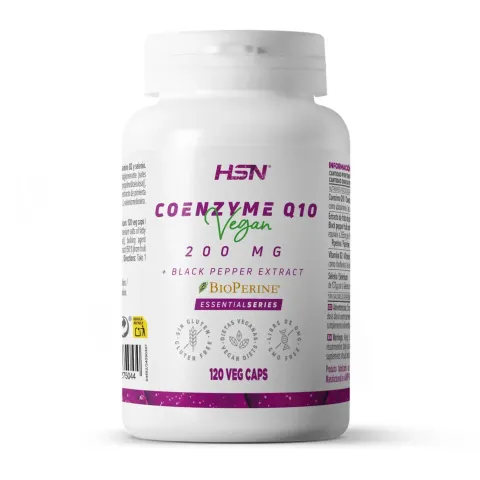
Coenzyme Q10 200mg + BioPerine® - High concentration
Coenzyme Q10 200mg + BioPerine® from EssentialSeries is a vegetable capsule dietary supplement made from the oxidized form of coenzyme Q10: ubiquinone, and black pepper extract standardized in piperine (patent BioPerine®), the formula has been complemented with vitamin B2 and selenium for synergistic activity.
Ubiquinone is the standard form of coenzyme Q10 because it is the oxidized form that our body mainly uses. In addition, its chemical stability and ease of storage by the person using it make it the most frequently used form in dietary supplements.
Our Coenzyme Q10 has been carefully processed to guarantee its concentration and activity, plus improved bioavailability thanks to the presence of BioPerine® (Badmaev et al., 2000).
Coenzyme Q10 200mg - Discover it and be amazed!
Unit dose: 200mg per capsule
When we talk about Coenzyme Q10 we see a variable dose range that usually lies between 30 and 200 mg daily.
The lower doses (30-100 mg) are commonly used for daily maintenance, while higher doses (100-200 mg) are reserved for situations where a more specific effect of the compound is sought.
The Coenzyme Q10 you’re looking at has a unit dosage of 200mg, so it sits at the high end of the daily dose used. This dosage is ideal for people seeking the maximum effects and benefits of this important antioxidant, however, if that’s not you and you’re only after CoQ10 for light daily support, alongside other dietary supplements you already have chosen, you can opt for the 100mg presentation, also available in our catalog: Coenzyme Q10 100mg + BioPerine®.
An optimized formula with Vitamin B2 and Selenium
Our CoQ10s feature carefully selected nutrients added for their synergistic properties:
It’s included in the formula as it supports normal energy metabolism and helps reduce tiredness and fatigue, key properties sought by people using CoQ10.
That contributes to the protection of cells from oxidative damage.
Guaranteed stability: Coenzyme Q10 of maximum quality
Ensuring the stability of a compound used in a dietary supplement is essential to keep its nutritional properties intact from production to consumption. When a substance is unstable, it can degrade or transform easily due to factors like heat, light and oxygen, significantly reducing quality. In the case of coenzyme Q10, which is fat-soluble, it’s especially important, since its chemical structure can be altered more easily, affecting absorption and thus its bioavailability.
Ubiquinone, being the oxidized form, is much more stable than its reduced counterpart, ubiquinol. This greater stability allows us, thanks to our careful quality control throughout the production process, to preserve its integrity easily during storage in the user’s home, guaranteeing that the final product contains the amount stated on our CoQ10 label, throughout its shelf life. Ubiquinone is an excellent alternative to ubiquinol, as it offers a more resistant formulation and is much easier to store after first opening.
At HSN we follow controlled procedures with total traceability of the manufacturing process to guarantee the stability of all our dietary supplements, even the most degradation-prone ones.
A allergen-free and vegan-friendly formula
The Coenzyme Q10 200mg + BioPerine® product is fully vegan-friendly, and presents no incompatibilities with any dietary condition, as it contains no allergens in its composition.
Why does it contain BioPerine®?
We have studies like Badmaev et al. (2000), which indicate:
'The dietary supplementation of coenzyme Q10 with piperine produced a statistically significant area under the plasma curve, approximately 30% higher than observed during supplementation with coenzyme Q10.'
Piperine is an alkaloid found in the outer layer of black pepper grains (Piper nigrum) and is responsible for its spicy flavor; we have used the patent of the most widely recognized black pepper extract:
BioPerine® is a patented extract of black pepper grains, registered as a trademark by Sabinsa Corporation and stands out for its guaranteed 98.5% content of piperine.
Enjoy Coenzyme Q10 with the highest bioavailability thanks to the presence of piperine in our formula.
What other CoQ10 options do I have?
Besides ubiquinone, which comes in 100 mg and 200 mg presentations, you can opt for ubiquinol, the reduced form of coenzyme Q10.
Find it available with the best raw material in the world, in our catalog: Ubiquinol (Kaneka Ubiquinol™) 100mg.
Ubiquinone vs Ubiquinol, which should I choose?
In general, ubiquinone is the default presentation used to access the substance 'Coenzyme Q10'.
Milligram for milligram, ubiquinol is considered a more efficient form since it is the reduced form of coenzyme Q10, however, manufacturers must have superb control of their production process, and storing it at home is more delicate.
HSN’s ubiquinol is stabilized securely, so you can be sure that at every stage of the manufacturing process, the ubiquinol has been treated according to the standards for handling to prevent degradation, so the choice is in your hands:
- If you’re careful and can ensure proper storage at home, you can use Ubiquinol.
- If you’re planning to travel with the product, use it outside the home, or you’re not confident about temperature or humidity in the place you’ll store it; better ubiquinone.
Coenzyme Q10 and Monacolin K, what’s the relationship?
Monacolin K is the best-known active ingredient of red yeast rice. The metabolic pathway through which monacolin K exerts its physiologically positive effects is also responsible for the synthesis of CoQ10 in the body. This is why when monacolin K is consumed, endogenous CoQ10 production decreases, which can lead to lower levels. These effects are widely reported in scientific literature (Folkers et al., 1990).
That’s why there’s interest in supplementing red yeast rice with Coenzyme Q10.
Usage recommendations: is it for you?
Coenzyme Q10 can be used by all kinds of people looking to benefit from the nutritional properties of this compound, but specifically, there are 3 groups that benefit the most. These groups are:
- Older adults or seniors: With aging, CoQ10 levels in the body naturally decline. Older adults may benefit from its use as a dietary supplement to compensate for this lower endogenous synthesis (Barcelos et al., 2019).
- People with high physical demand or athletes: Those who perform intense or high-performance physical activity have higher energy needs and may experience elevated oxidative stress. Coenzyme Q10 is a common supplement among athletes with high energy demands.
- Individuals exposed to high oxidative stress: They may consider including a CoQ10-based dietary supplement, as well as other antioxidants such as ALA or vitamin C.
What other products does CoQ10 work well with?
Coenzyme Q10 can be used with any other dietary supplement, as it has no contraindications. The products most commonly used alongside CoQ10 are:
References to scientific studies
- Badmaev, V., Majeed, M., & Prakash, L. (2000). Piperine derived from black pepper increases the plasma levels of coenzyme Q10 following oral supplementation. The Journal of nutritional biochemistry, 11(2), 109–113
- Drug and Therapeutics Bulletin. (2015). Coenzyme Q10 and statin-related myopathy. BMJ: British Medical Journal, 53(5), 54–56.
- Barcelos, I. P., & Haas, R. H. (2019). CoQ10 and Aging. Biology, 8(2), 28.
- Folkers, K., Langsjoen, P., Willis, R., Richardson, P., Xia, L. J., Ye, C. Q., & Tamagawa, H. (1990). Lovastatin decreases coenzyme Q levels in humans. Proceedings of the National Academy of Sciences of the United States of America, 87(22), 8931–8934.
- Qu, H., Guo, M., Chai, H., Wang, W. T., Ga, Z. Y., & Shi, D. Z. (2018). Effects of coenzyme Q10 on statin-induced myopathy: An updated meta-analysis of randomized controlled trials. Journal of the American Heart Association, 7(19), e009835.
- Sarmiento, A., Diaz-Castro, J., Pulido-Moran, M., Kajarabille, N., Guisado, R., & J. Ochoa, J. (2016). Coenzyme Q10 Supplementation and Exercise in Healthy Humans: A Systematic Review. Current Drug Metabolism, 17(4), 345–358.
- Tabrizi, R., Akbari, M., Sharifi, N., Lankarani, K. B., Moosazadeh, M., Kolahdooz, F., … Asemi, Z. (2018). The Effects of Coenzyme Q10 Supplementation on Blood Pressures Among Patients with Metabolic Diseases: A Systematic Review and Meta-analysis of Randomized Controlled Trials. High Blood Pressure and Cardiovascular Prevention, 25(1), 41–50.